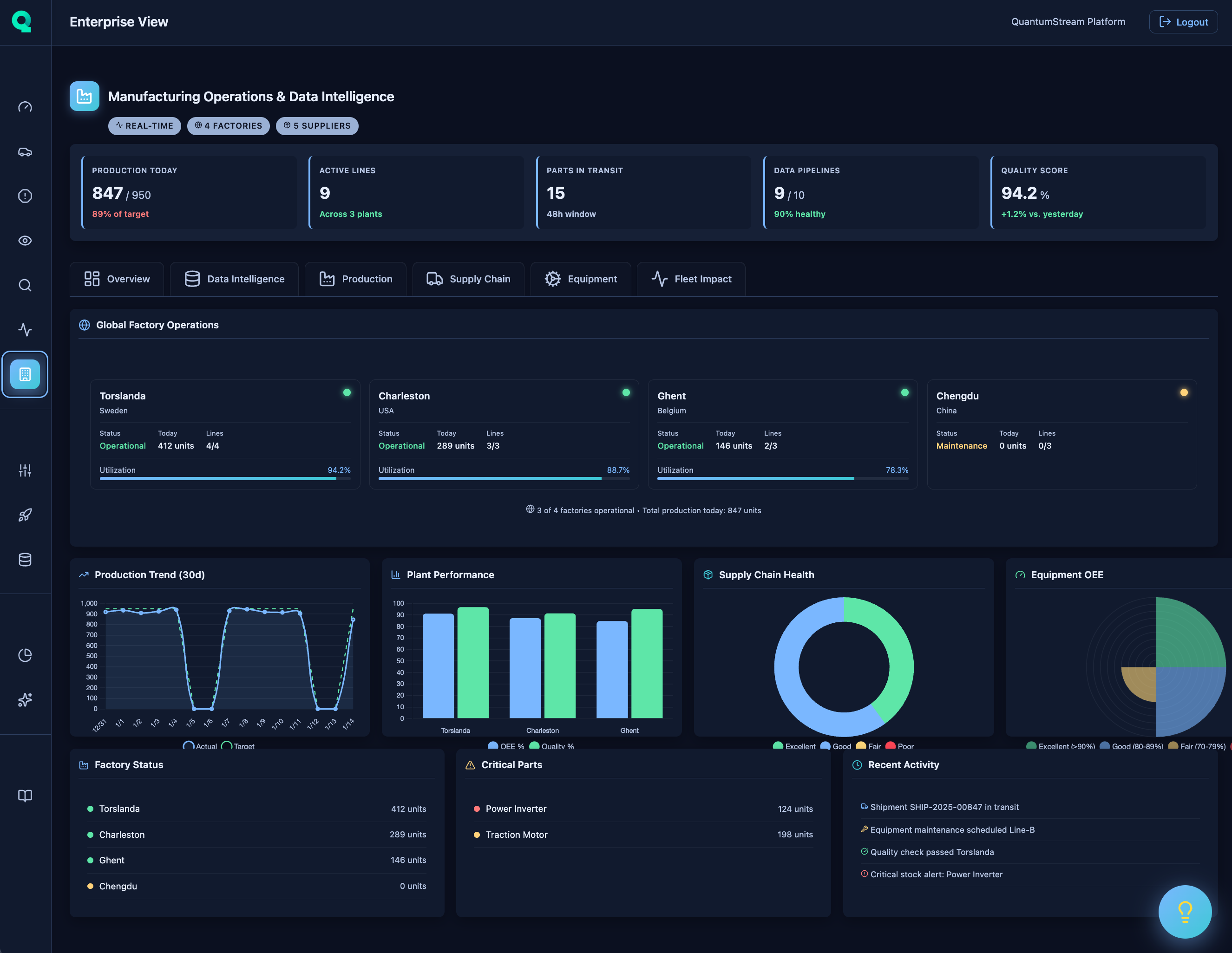
Link every incident to its manufacturing and supply chain origin. Track supplier risk, batch-level failure rates, and detect quality issues 6-8 weeks earlier than traditional methods.
Weighted scoring based on incident count (40%), severity (25%), batch correlation (20%), and trend direction (15%). Identify problematic suppliers before fleet-wide impact.
Station-level incident correlation. Track which assembly stations produce higher failure rates. OEE (Overall Equipment Effectiveness) monitoring by line, shift, and plant.
Component batch tracking from manufacturing to field. Identify problematic batches with 3.2x higher failure rates. Link VIN → Part Number → Batch → Supplier.
Compare plant performance across locations. Production units vs. target, efficiency by model/line/shift, quality pass rates, and defect tracking.
Monitor 10-15 data pipelines: S3 telemetry, SQS queues, VictoriaMetrics, Kafka streams. Volume, throughput, latency, and health status for each pipeline.
Performance score (0-100), on-time delivery rate, quality acceptance rate, defect rates, lead times, and active/pending orders for each supplier.
Cross-correlate manufacturing issues with field incidents. Time lag between production and incident, incident clustering by production date, warranty cost attribution.
Detect supply chain and manufacturing quality issues 6-8 weeks earlier. Example: Bad coolant pump batch identified after 14 incidents vs. 86 incidents in traditional approach.
Per vehicle per year savings. Supply chain issues caught before widespread impact. Prevent recalls and emergency service campaigns.
Every component traced from supplier → batch → assembly station → VIN → field incident. Full audit trail for warranty claims and regulatory compliance.
Data-driven supplier scorecards. Identify underperforming suppliers and batches with quantifiable metrics. Enable targeted corrective actions.
See how enterprise integration connects manufacturing, supply chain, and field incidents for complete traceability.